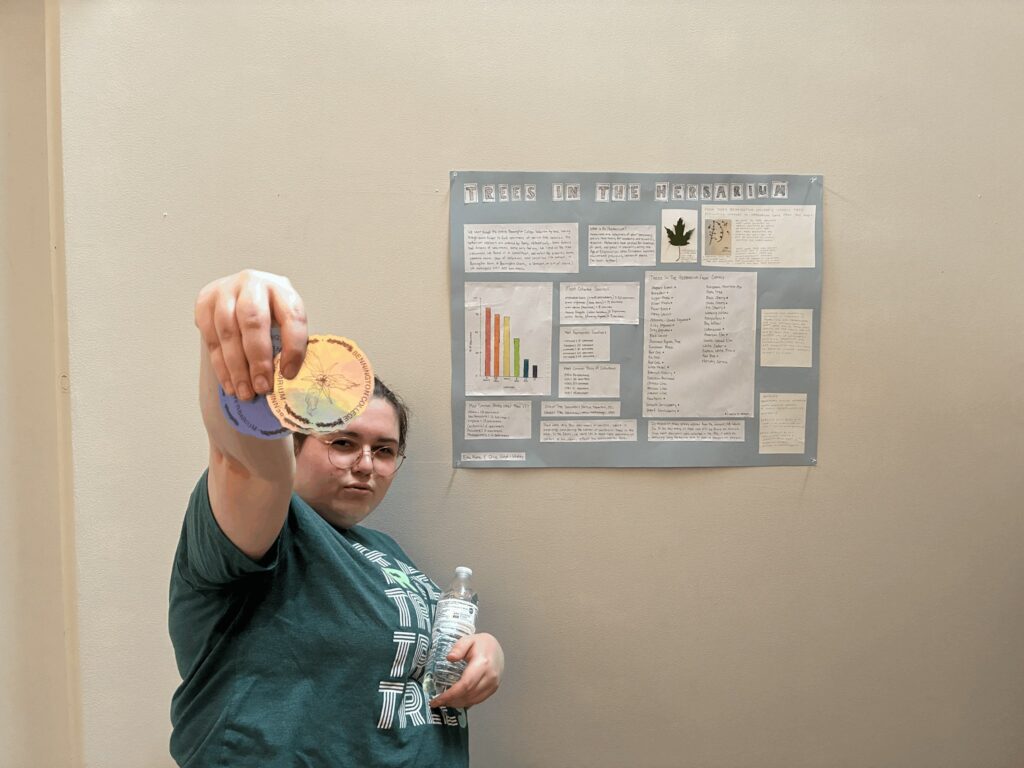
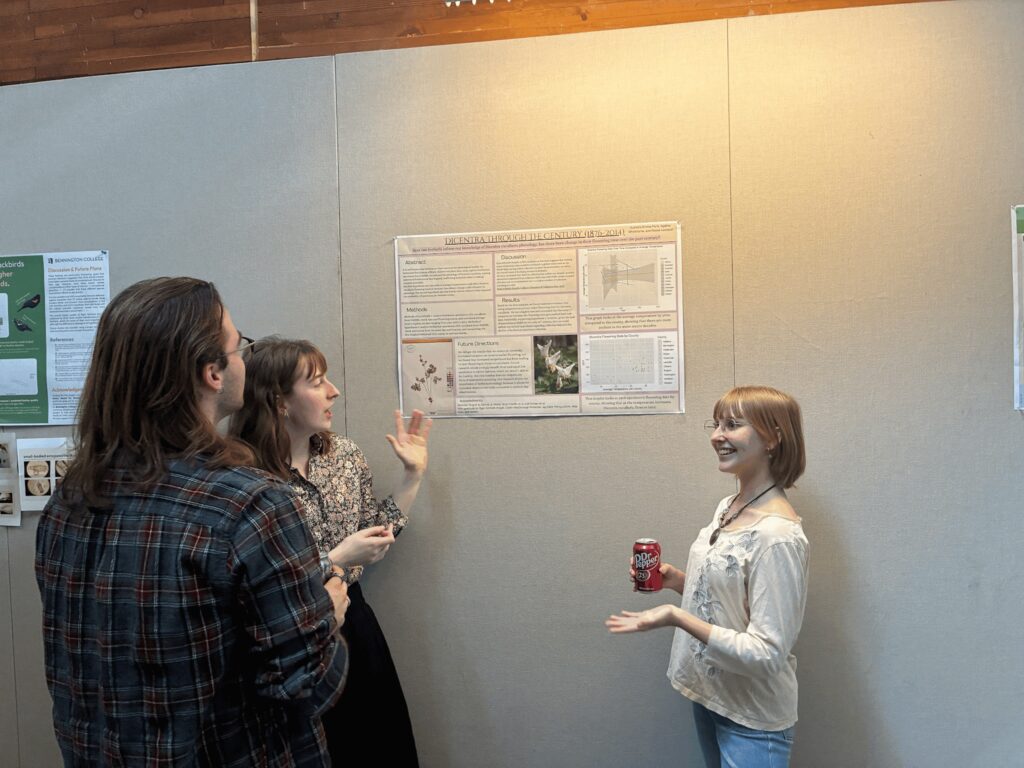
On the final Friday of the year, Bennington College STEM students gathered in the Dickinson science building for Posterpalooza, the annual poster presentation/pizza party. At the event I saw a wide range of posters being presented. Students showed posters on Emerald Ash Borer and the destruction of Ash trees on our campus, posters analyzing herbarium data, posters created through astronomy and physics tutorials, and more.
Students, professors, and visiting friends and family walked the halls and asked questions. As I presented my poster I had many great conversations about my data and how it could be used in collaboration with other students’ projects and research.
Poster creation is a common final project for science and math courses and lets students decide how best to visualize their research. This year I saw many large posters with beautiful graphics as well as hand painted, detailed analog designs. Posterpalooza is a great opportunity for everyone to gather and see what we have been working on this year, and pick up a few brand new Bennington Herbarium stickers from Etta!
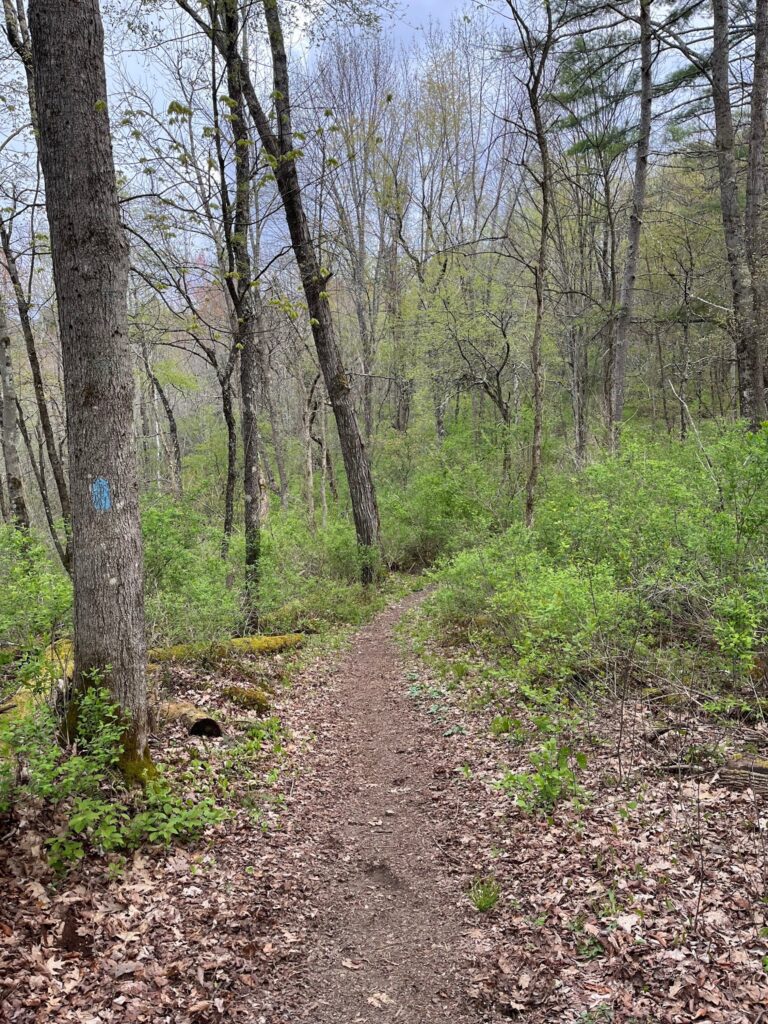
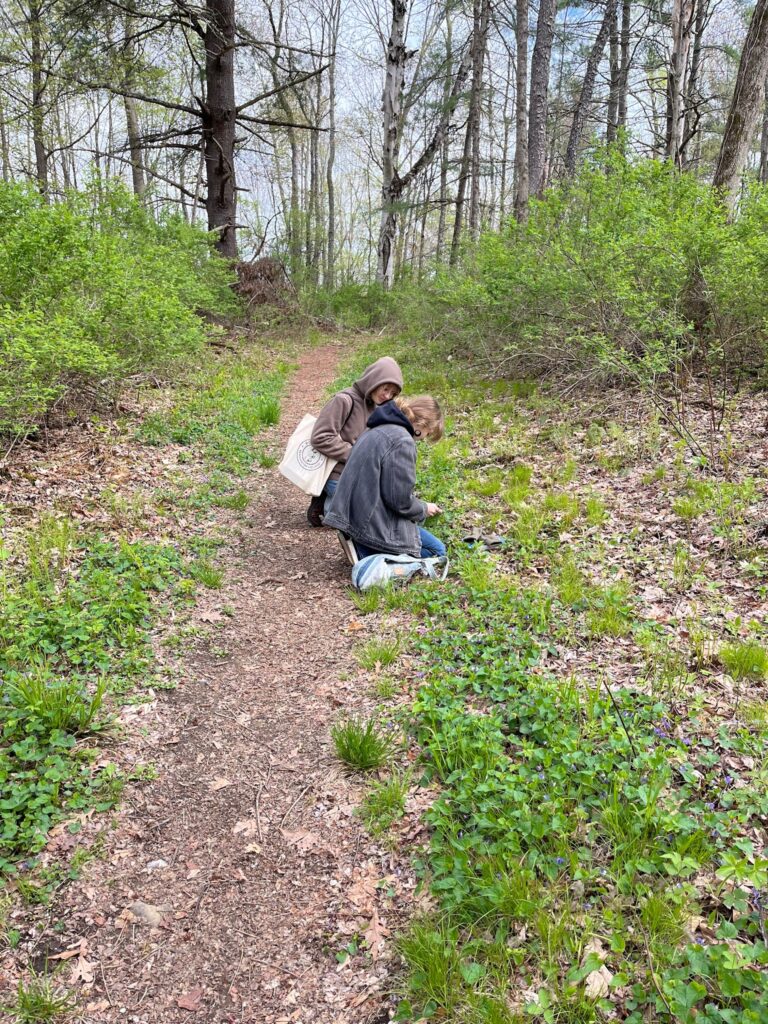
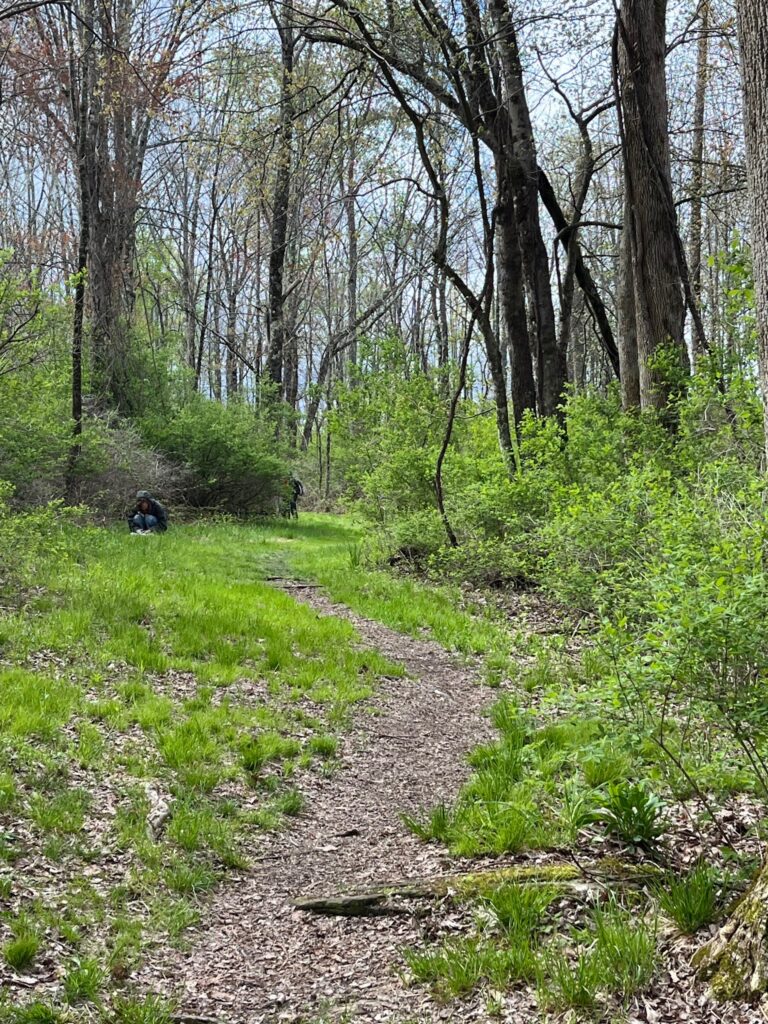
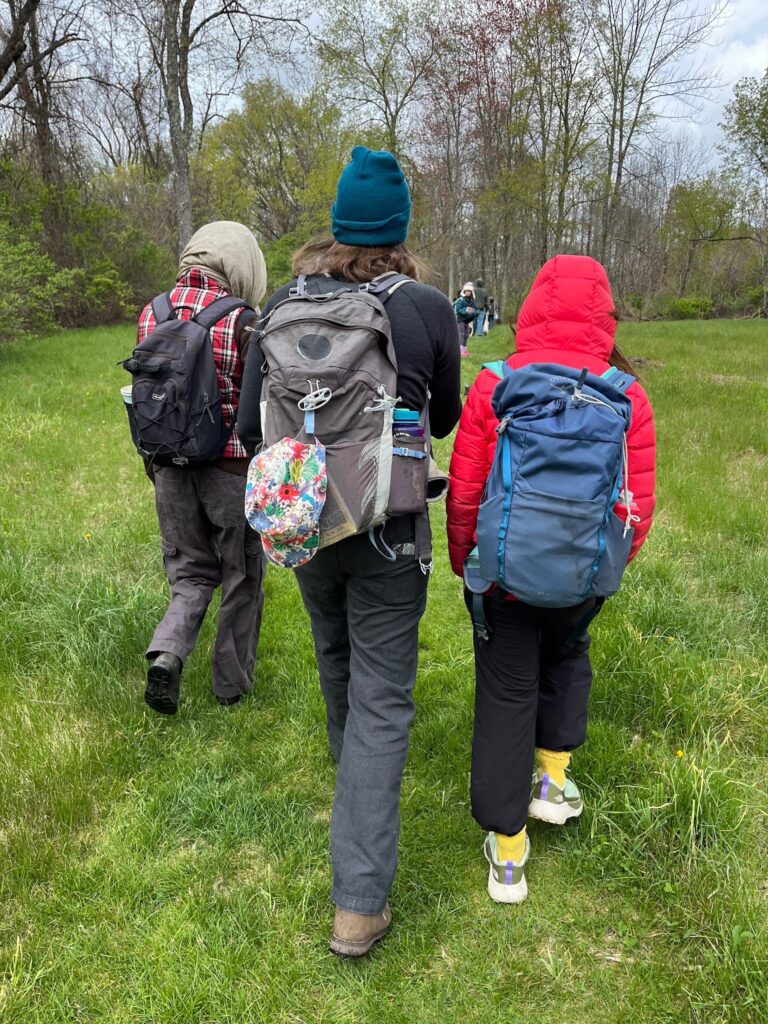
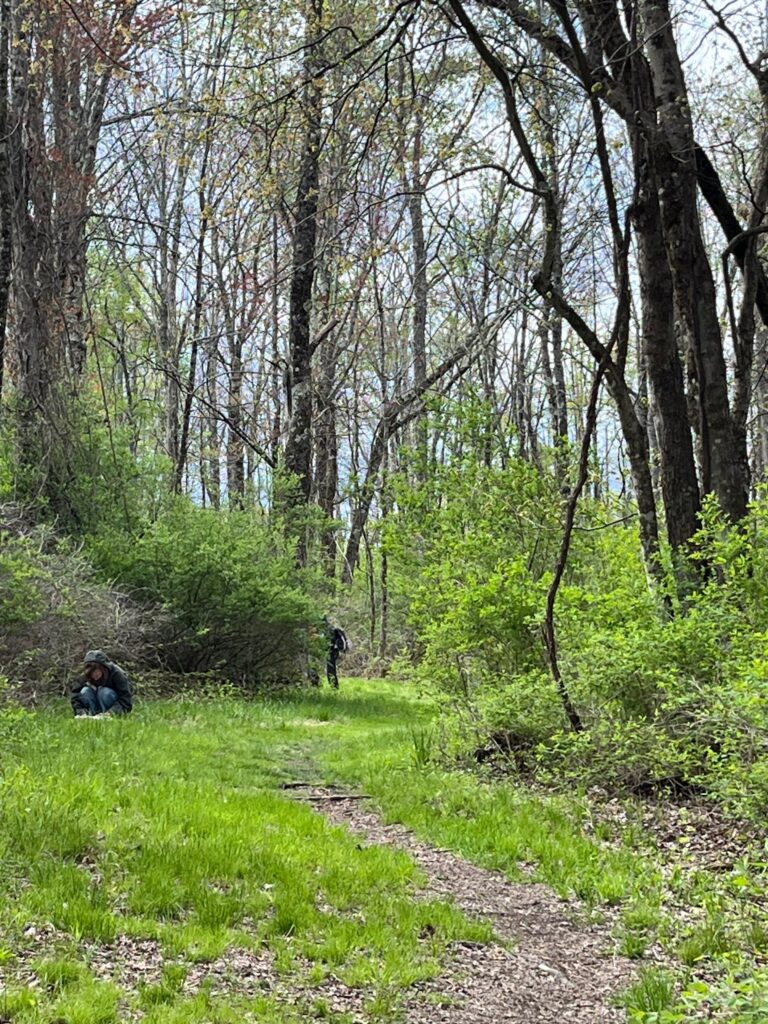
On Sunday, May 3rd, our student group – including Caitlin and her two daughters – went on a specimen collecting trip to the Robert Frost Stone House. Using Newcombs Wildflower Guide, we first identified what species of plant we were observing. The removal of spring ephemerals (Blood Root, Dutchman Breeches, etc.) was strictly forbidden during our excursion, as they act as an indicator species for the local environment’s overall health. After identifying the species of plant, we then used shears to remove most of the plant, including leaves and, if present, any flowers. Flowers can make identifying a species much easier, especially once it’s been dried and pressed in a herbarium. After carefully removing the plant, we gently placed it in between sheets of newspaper. This is an important part of the process, because however the plant is arranged in the newspaper will be its final form for the rest of its time as a specimen. Once it’s been dried, most of the time you cannot reconfigure any leaves or flowers, so it’s important that any distinct characteristics are visible when it is being preserved and collected. That way, future botanists will have a more accurate image of your specimen’s original state into the future. After gently placing the specimen onto the newspaper, it is sandwiched between two sheets of blotting paper, and then two sheets of cardboard, and finally two wooden frames that are secured with adjustable straps. These components help dry out and press the specimen flat, so that the sample is ready to mount onto a piece of paper and remains undamaged.
After collecting our plants, we headed back to campus. The plant presses remain assembled for roughly a week, after which the specimens will be dry enough to be ready to be mounted. Next, the flattened plant is glued to its paper, along with a label. This label includes a variety of information about the plant and the sample itself, including the plant’s name, species, genus, and plant family. Additionally, it notes when the collection took place, who collected it, and where it was found, as well as any other useful ecological information on the habitat where it was located (e.g., co-occurring plant species, topography, substrate, etc.). Sometimes, scientists even describe how the specimen looked when collected, as over time the colors and even shape of the plant can change, which can make identifying or studying the plant’s characteristics difficult.
All of the information collected, from the ecological data to the date of collection itself, can be used for future studies. Once mounted, the specimens will be stored in cabinets in the Bennington Herbarium for future use, and will eventually be scanned into a digital online database of the herbarium. All of this will contribute to growing the herbarium so that future students can access it for their studies, providing an opportunity to create a more accurate biological image of the local ecosystems at a set point in time.
As part of The Herbarium (BIO4441.01) students engage in research and present their findings to the class. The most recent of these presentations focused on genera and how they are being used in the herbaria based research projects each student is a part of. This post will focus on the genus Rhus L.
Rhus in botany:
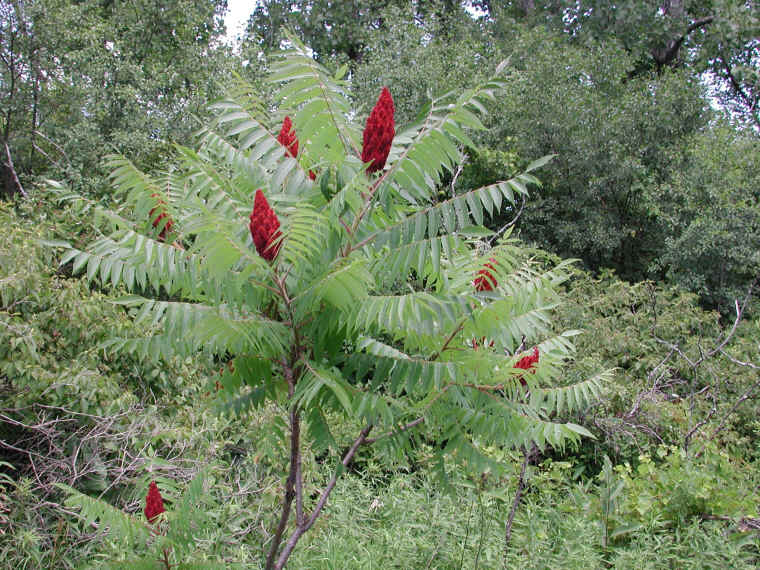
Rhus L., or Sumac, is a member of the Anacardiaceae family. This family is described by the presence of laticifers (resin ducts) in the plant and generally produce fruits with resinous mesocarps. Notable members of this family include Cashew and Mango. Laticifers are specialized cells that accumulate and transport latex through the plant, aiding in the synthesis of certain metabolites and herbivory defence. The mesocarp is the middle layer of the fruit wall (pericarp) and is often the part of the fruit that we consume.
Members of the Rhus genus can be identified by the following characteristics:
Growth form: Woody shrub, small tree, or vine
Leaves: Pinnately compound alternate branching leaves. Margins are serrate (poison Sumac’s are entire)
Flowers: Short stalked and small with five petals. Male clusters are larger than female clusters and have five yellow-tipped stamens. Female clusters have three parted styles and form fuzzy drupes. The calyx has five pointed lobes.
Rhus in Vermont:
According to the Flora Novae Angliae, there are four species of Sumac in Vermont: R. aromatica, R. copallinum, R. hirta, and R. glabra. However, herbaria records from the state suggest that there is also a significant population of R. typhina as well.
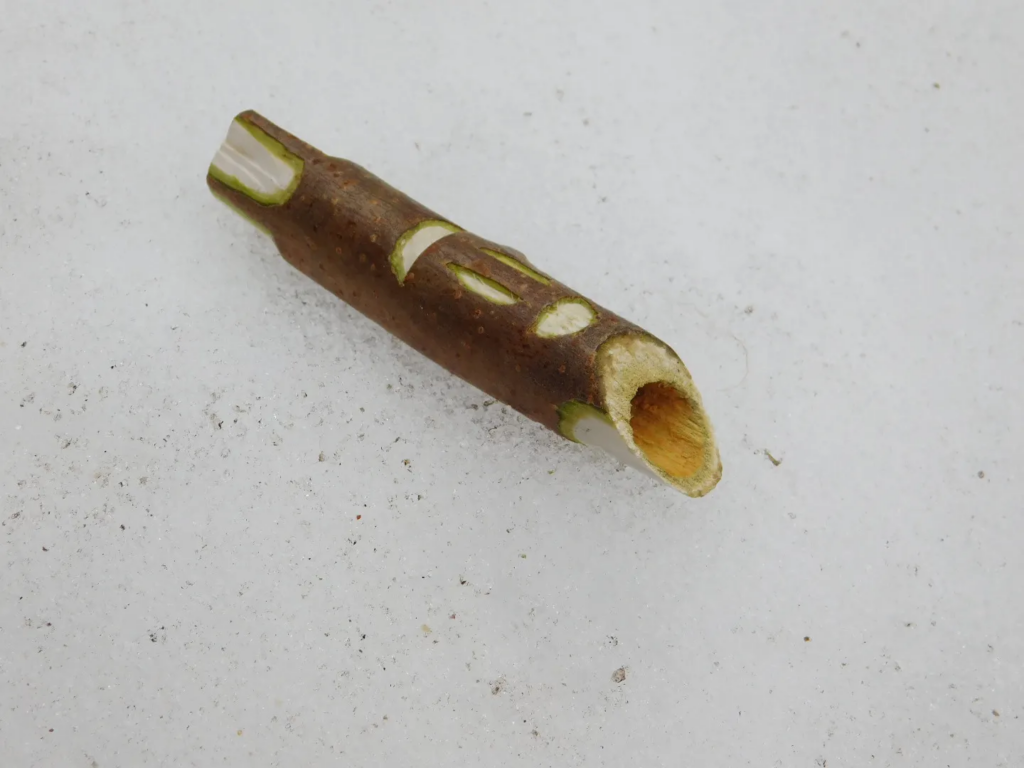
This genus has been an important part of the Vermont region’s cultural history through its ties to the Abenaki people. The fruit from most sumac, which is small and mostly pit, was boiled to create a flavored drink or crushed and smoked with tobacco. The stems are also traditionally used to create spiles for maple sugaring. Sumac was favored for this purpose due to the rigid exterior and punky interior, making the hollowing process easier.
Elsa Rubin Leopold and Rudolf Blasschka were a father-son team of artisan glass craftsmen that produced highly detailed botanical models for scientific research. The Blashka family was from Czechia, an area with a long tradition of highly specialized craftsmanship in glass, metal, and precious stones (National Museum of Scotland). The family business specialized in jewelry, intricate glass eyes and ornaments. Rudolf Blashka had a lifelong fascination with the natural world, and initially made his living selling glass flowers for decorative purposes, along with glass eyes (National Museum of Scotland). During 1853 sea voyages, Leopold captured and sketched marine invertebrates and re-created them in glass, increasing over time in detail and accuracy (University of Wisconsin–Madison). The glass models of sea creatures gained popularity, and were purchased widely for personal collections by royalty and commissioned by various museums for natural displays (University of Wisconsin–Madison). The family relocated to Dresden when Leopold’s son Rudolf was born in 1857. At the age of 23, Rudolf began helping his father create the glass models (National Museum of Scotland).
In 1886, the Harvard Glass Flowers were commissioned by Professor George Lincoln Goodale, founding director of Harvard’s Botanical Museum (Harvard University). Over the course of 50 years, Leopold and Rudolph produced a total of 4,300 replica plant specimens of 780 plant species for exclusive display and use by Harvard University. The models include scale replicas of each full plant, and “magnified” enlarged glass models of individual plant components, including stamens, pistons, and cross sections of stems. The models also often represent roots and the complete phenological stages of the plant. The Blashkas glass models made a unique and invaluable contribution to natural history displays due to their scientific accuracy, beauty, and durability. Unlike the delicate tissue of pressed plant specimens, the glass models do not degrade with light or humidity, changing the way that students and the public can interact with botany (National Museum of Scotland). Herbarium specimens, while valuable for a wide range of research purposes, often distort morphological details of plants. A dried, pressed plant may change color, size, or otherwise differ in structural detail from its living form. The glass models allow for three dimensional observation, without the barrier of seasonality, availability, or transport. Prior to photography, this was transformative for education, as plants with drastically different habitats could be observed together. Some plants in the Blashka glass model collection are not possible to preserve though pressing, such as plants with large fruits or delicate, brittle seed pods. The Glass Flowers continue to be relevant and went through a renovation process in 2016 that included updated scientific interpretation on the models (Harvard Museum of Natural History). The level of detail captured in glass and the quantity of specimen models produced leave behind somewhat of a mystery. The techniques developed by the Blashka’s have been lost to time, although we know they were based in lampworking. Lampworking technique involves working in a direct open flame, rather than a forage. Done on a workbench, the flame is powered by foot pedal air bellows burning paraffin wax. Leopold had a preference for doing lampworking, and Rudolf preferred to paint the models. While made primarily of glass, the detail extended to the level of adding hairs, herbivore damage, and veins to the plants (Cannon). The assembly techniques and methods for achieving this detail are not fully understood. In the United States, the Blashka Models are on display at Natural History Museums around the country. The largest collection of the Blashka’s flowers are at Harvard Museum of Natural History in Cambridge Massachusetts, and a collection of 700 marine invertebrates is on display at Cornell University’s Museum of the Earth in Ithaca, New York (Cornell University).
Wolfgang Anderson Karl Blossfeldt (1865-1932) was a German photographer, sculptor and teacher. He is known for his close up photography of plant life, abstracting their form, and subverting the ordinary. The photos almost feel alien and the high contrast and emphasis on texture gives the viewer a sense of fear and displacement, like we were never supposed to notice the detail around us. It is hard to believe that he was making these photographs in the early 1900s.
He originally made these photographs as teaching tools to study natural forms and to apply them to sculpture, design and engineering. The photos were never meant to evoke the otherworld feeling, he did see the chaos that many did in the photographs. He saw natural forms as art within themselves, every curve, texture and mechanism already existed long before humans tried to imitate them and blurring the distinction between organic growth and manufactured structure.
His most famous book named Urformen der Kunst or “Art Forms in Nature” translated to english is a collection of plant photography all with blank backgrounds, the removal from their environment, they stop feeling alive and begin to resemble a specimen, scientific or other. This philosophy closely resembles an Herbarium sheet, it highlights the form, erases noise and distractions while also reconstructing the perspective under Blossfeldt’s vision. What’s interesting about this art is how it changes your relationship with these plants especially under a lens of the 1900s. Blossfeldt’s photography does not simply document these plants like an herbarium sheet but redefines and reconstructs the forms.
I’ve created an artificial herbarium plant specimen which emulates the Canadian milkvetch or the Astragalus canadensis. The artificial plant specimen is a concept created by Albero Baraya who had a quest to create an herbarium made up of artificial plants from around the world. The astragalus canadensis is native to North America and is found almost everywhere in the continent with a few exceptions. In New England it is relatively rare. It is mainly present in Western Vermont along the Lake Champlain area and in headland (Go Botany). Shea Hagan For context, an herbarium is a collection of plant specimens that have been found and flattened in a plant press. Then, once it has had some time to flatten it is glued to a thick sheet of paper and given a label. The label should specify the species, the precise location of where the specimen was found, details about the kind of environment where the specimen was found, the collector name and the date that it was collected. Herbaria are important for ecologists, botanists, biologists and any other science field where plants are studied. Herbaria are used to better understand specific things about different species and to identify any botanical patterns that occur over time. The Astragalus Canadensis is very important for the soil as it is a nitrogen-fixing plant. This means that once nitrogen goes from the atmosphere to the soil, the Astragalus Canadensis converts that nitrogen into a form that can be absorbed by the roots of plants. Nitrogen is one of the most vital nutrients and it supports the fertility of the soil and helps the surrounding vegetation with germination, photosynthesis, growth and fighting off disease. (Sharman) (Canadian Milk Vetch – Grow & Use in Northern Gardens: Northern Medicinal Plants) If you are out and about and come across a plant with lots of small white and yellow flower petals, take a moment to appreciate all the beautiful work it’s doing to give life to its ecosystem!
Work Cited “Astragalus Canadensis – Canada Milk-Vetch.” Native Plant Trust: Go Botany, gobotany.nativeplanttrust.org/species/astragalus/canadensis/. Accessed 19 May 2026. “Astragalus Canadensis Photos Saskatchewan Wildflowers.” Astragalus Canadensis Photos Saskatchewan Wildflowers, Glen Lee, www.saskwildflower.ca/nat_Astragalus-canadensis.html. Accessed 19 May 2026. “Canadian Milk Vetch – Grow & Use in Northern Gardens: Northern Medicinal Plants – Grow, Learn, & Use Herbs.” Naturewithus.Com, naturewithus.com/plants/herbaceous-plants/canadian-milk-vetch. Accessed 19 May 2026. Sharman, Sarah. “Nitrogen-Fixation: Healthy Soil, Happy Plants, Full Bellies.” HudsonAlpha Institute for Biotechnology, 28 Apr. 2022, www.hudsonalpha.org/nitrogen-fixation-healthy-soil-happy-plants-full-bellies/.
The Rhamnus L. Genus, under the family Rhamnaceae, and the authority of Carl Lineaus, is a group of small shrubs or trees with berries. There are 140 recognized species in the genus found all across the world, but only four can be found here in New England– two of which are incredibly invasive.
You can identify them through their cyme-like flower clusters and prominent blade vanes on each compound leaflet. In the late summer, these flowers grow into small dark blue/purple berry clusters. The berries are edible, so keep an eye out!
Due to their prevalence, many herbarium specimens have been taken of common buckthorn, including this one found by Walter T. Kittredge in 2013. He found it in Middlesex County MA, around many other invasive plants such as bittersweet and garlic mustard.
Recognizing these plants is important to maintain their population and cut back on their rampant growth. Buckthorn will continue to outcompete local plants, so keep an eye out for those small berries and flowers, harvest them or pull them up if you have the tools. Because together we can help our local ecosystems, and get a snack out of it!