by Devon Giardini

Image citation: Anna Atkins, botanist and photographer | creator of the world’s…
Early Life, Upbringing, & Illustration:
Born in Kent, England in 1799, Anna Atkins (formerly Anna Children) was an only child raised by a single dad. Having lost her mother early in life, young Anna developed a close bond with her father–John George Children–who was a well-respected scientist employed by the British Museum. Growing up immersed in the world of science, Anna’s interest in biology was stoked and encouraged throughout her childhood. Though women were prevented from professionally pursuing scientific interests, Anna–like many nineteenth century female scientists–found her way into the world of biology through illustration.
Atkins’ became an accomplished scientific illustrator early in her life. Working alongside her father to publish an English translation of Jean Baptiste de Lamarck’s Genera of Shells, Atkins had completed 256 scientifically accurate shell drawings by her early twenties. Atkins spent her life living and working in southeast England and married her husband–John Pelly Atkins, a merchant and landowner who shared her interest in science–when she was 26 years old. Although Atkins’ work as an artist and scientist began with invertebrates, by the time she was thirty Atkins began to collect, illustrate, and document botanical specimens.
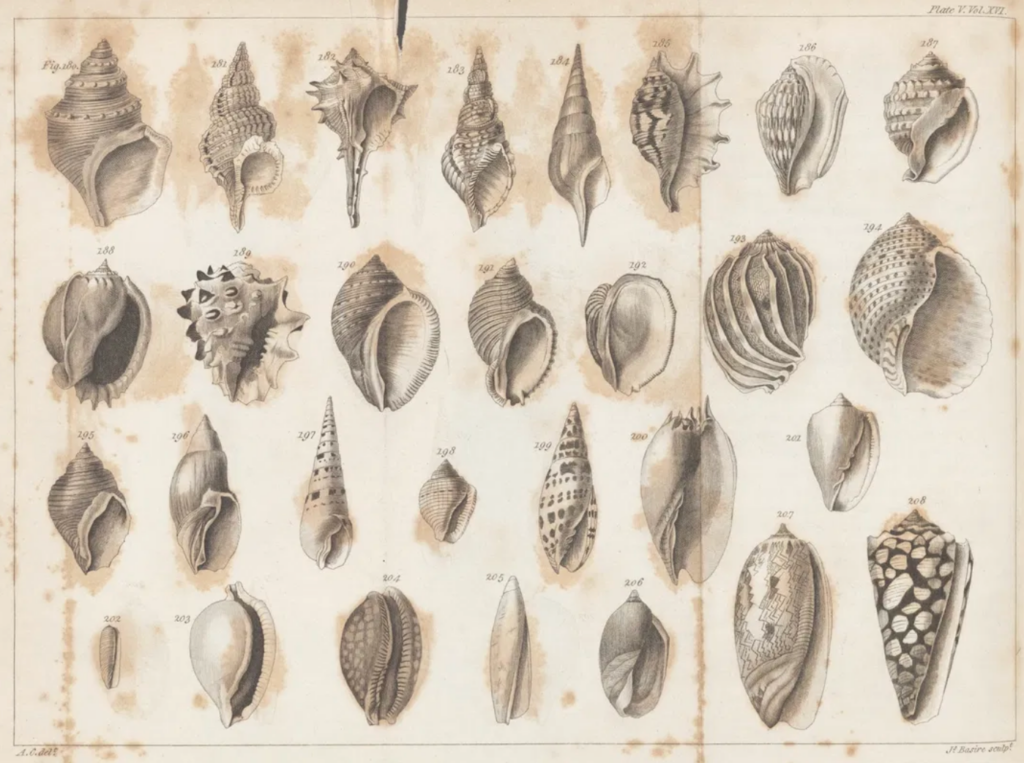
Image citation: ‘Shells’ by Anna Atkins from Genera of Shells (1823)
Cyanotypes and the World’s First Photobook:
Atkins’ interest in botany was intense and lifelong. Although prevented from pursuing a scientific career, Atkins’ involvement with the Royal Society–a connection built in association with her father–was steadfast. Atkins’ connections within the scientific community and her rapport with other scientists served her well throughout her career. In fact, her correspondence with William Henry Fox Talbot–the inventor of the “talbotype”–and friendship with Sir John Herschel, led her to experiment with photographic processes earlier than many. With the first publication of her most renowned work, “Photographs of British Algae: Cyanotype Impressions” in 1843, Atkins became the first person to publish a book illustrated entirely with photographic images.
A culmination of Atkins’ decades-long study of British seaweed, each copy of “Photographs of British Algae: Cyanotype Impressions” contained hundreds of prints. To create the 14 substantially complete original copies we know of today, Atkins’ must have created approximately six thousand prints, each one by hand. The original copies of her book are now housed at institutions like the Linnaean Society and the Metropolitan Museum of Art. Capturing detailed and accurate impressions of the aquatic life she studied, Atkins’ books demonstrated the powerful potential of scientific photography.
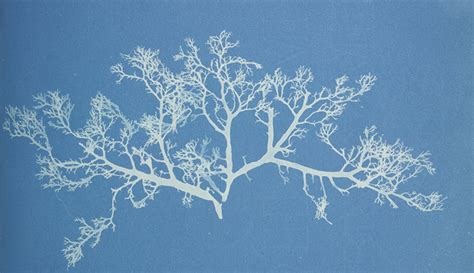
Image citation: Anna Atkins’s cyanotypes: the first book of photographs | NHM
Reception & Modern Connections:
Despite the revolutionary nature of Atkins’ work, the implications of her work were largely overlooked during her time. By the late 19th century, just a couple decades after her death in 1871, her work had been largely forgotten by the scientific community. In fact, before later research conducted by Larry Schaaf in the 1970s brought Atkins’ work back to the surface, William Talbot’s publication, “The Pencil of Nature,” was considered the first photographic book. Modern inquiry into the history of photography has helped bring Atkins’ work the renown it deserves. Centuries after their creation, Atkins’ cyanotypes remain beautiful, accurate, and detailed contributions to both botany and art.
Herbaria endeavor to document and preserve botanical information, and–as discussed by Maura C. Flannery in her book “In the Herbarium”–this archival work has historically existed between the worlds of art, science, and innovation. Though modern herbarium collections focus on preserving physical plant matter, they still contain illustrations and photographs used for identification. Technology has been shaping herbaria for centuries and is still changing the way we document plants and conduct research. Photography has come a long way since Atkins’ time and modern artists like William Arnold are using this technology to document plants in new ways. In their shared endeavor to accurately document and describe plant life, Anna Atkins’ cyanotypes and herbarium specimens pursue a common goal. Though each approaches botanical documentation differently, both methods contribute unique and important aspects to the preservation process.
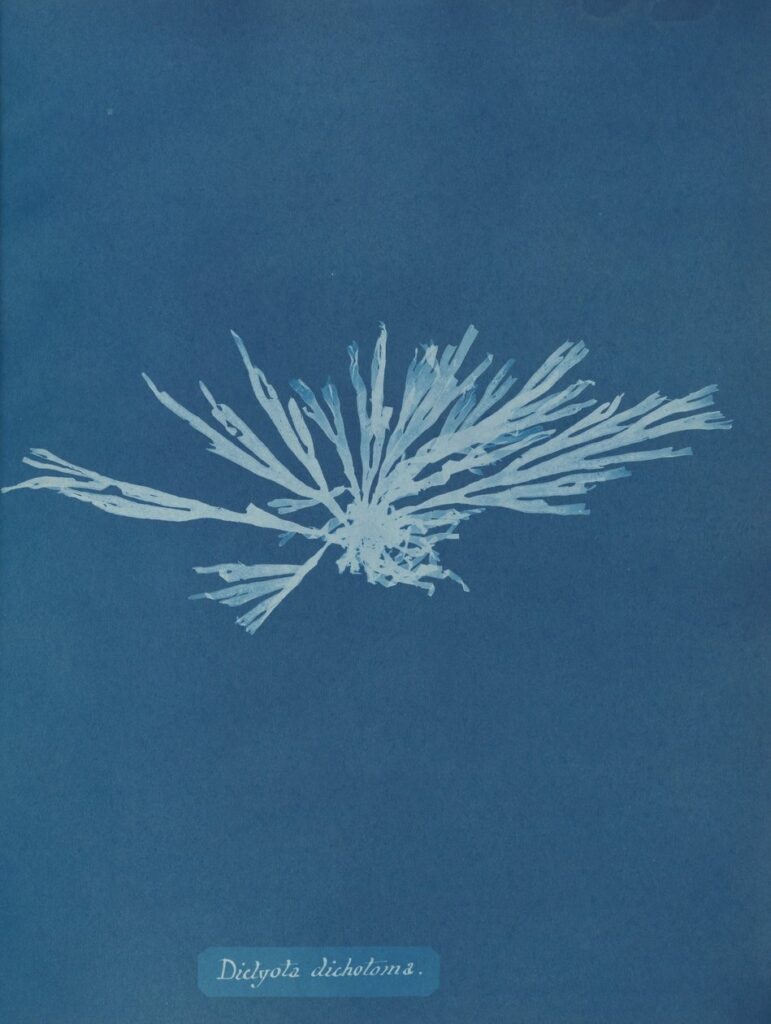
Image citation: Meisterdrucke
Links & Citations:
- Flannery, Maura. In the Herbarium: The Hidden World of Collecting and Preserving Plants, Yale University Press, 2023.
- Suburban Herbarium – William Arnold
- Navigating Boundaries in the Photography of Anna Atkins — Lady Science
- Anna Atkins’s cyanotypes: the first book of photographs | Natural History Museum
- No Longer Anonymous: Anna Atkins and her Algae | Smithsonian Ocean
- Anna Atkins | MoMA
- Anna Atkins’ Cyanotypes – The Blueprint for Photography
- Anna Atkins and the cyanotype process (article) | Khan Academy
- Anna Atkins — AWARE
- How the First Female Photographer Changed the Way the World Sees Algae
- Anna Atkins – Photographs of British Algae: Cyanotype Impressions – The Metropolitan Museum of Art
Leave a Reply