By Kai Bjork
Ferns represent an ancient clade of vascular plants, first evolving out of the middle Devonian before radiating evolutionarily in the late Cretaceous. As such, there is a wealth of questions regarding their evolutionary history and much that can be learned about the process of evolution itself.
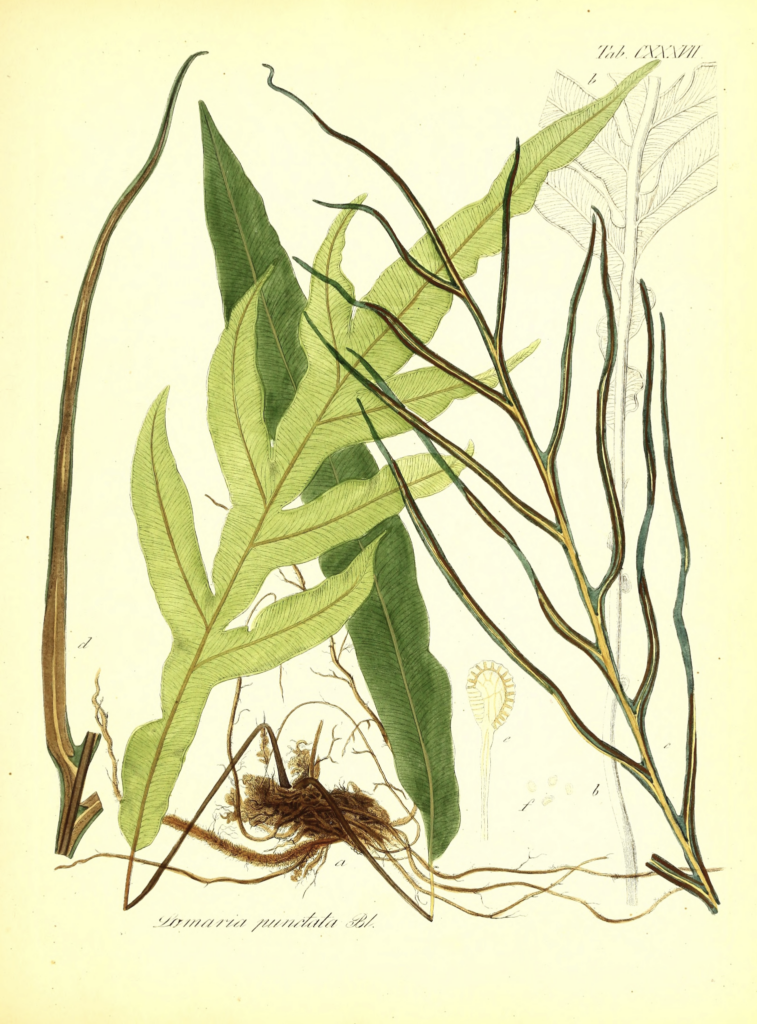
In their 2025 study, “The evolution of reproductive leaf dimorphism in two globally distributed fern families is neither stepwise nor irreversible, unless further specialization evolves,” authors Jacob S. Suissa and Makaleh Smith seek to do just that. In the paper, the authors investigate the reproductive strategies of two closely related families of ferns, the Blechnaceae and Onocleaceae, to see if they follow what’s known as Dollo’s Law. This “law,” first proposed by Belgian paleontologist Louis Dollo, states that it is impossible or improbable for an organism to evolutionarily return to a previous evolutionary state. More accurate to contemporary usage—it describes how, as a derived trait gains sufficient layers of complexity, it becomes increasingly unlikely that the continued evolution of that trait would result in a reversal to an
identical past form. To investigate Dollo’s law in ferns, the authors used digitized herbarium specimens as a source of morphological data, where images of the ferns had specific traits masked out and isolated before being analyzed. The result of their analysis showed two distinct forms of reproductive strategy present in the ferns, monomorphic and dimorphic. The monomorphic strategy is characterized by leaves with non-specialized functions where sporangia—a reproductive structure enclosing the fern’s spores—is present on the underside of the same leaves that are used for photosynthesis. The dimorphic strategy, on the other hand, is characterized by leaves that either have entirely specialized leaves where the entire frond is used primarily for reproductive purposes or partially specialized leaves where the frond has an identifiably different structure than the main photosynthesizing leaves but is covered in less than 50% sporangia.
After identifying these distinct forms, the authors were able to reconstruct a phylogeny of the ferns to see how they evolved over time, and importantly for understanding Dollo’s law, identify the direction of evolutionary transitions too and from traits. Amazingly, the authors found that for the reproductive strategies of monomorphism and dimorphism there were multiple instances of trait reversal where a species evolved a dimorphic strategy and then reverted to a monomorphic one.
However, there’s more to the story. The authors also looked at a trait in ferns where the pinnae move in response to the humidity of the environment. To quantify this trait in ferns the authors originally planned to use temperature- and humidity-sensitive chambers. Unfortunately, the authors were doing their research during the height of the Covid pandemic—and so they had to get creative. As a substitute for the climate-controlled chambers, the authors used a zip-lock bag, wet paper towels, an iPhone, and an oven. To simulate the conditions of 100% humidity, they placed the pinnae into the zip-lock bag with the wet paper towel and recorded images with the iPhone. And, to simulate 0% humidity, they put the pinnae into an oven at 100 °F! Luckily it has been found that for the species they were working with, temperature has little to no effect on fertile
fronds. Crucially, though, this trait of humidity response is highly specialized, only appearing in dimorphic species and facilitating the effective dispersal of spores during the early spring. This specialization was reflected in the results from the prior phylogenetic analysis, with no species that presented humidity responsiveness showing reversals. The results showcase the nuances of Dollo’s Law—showing both an instance where it doesn’t hold true and how evolutionary traits become fixed through specialization and increasing networks of interdependencies.
Sources
Jacob S Suissa, Makaleh Smith, The evolution of reproductive leaf dimorphism in two globally distributed fern families is neither stepwise nor irreversible, unless further specialization evolves, Evolution, Volume 79, Issue 2, February 2025, Pages 164–175, https://doi.org/10.1093/evolut/qpae159
Kunze, Gustav, Die Farrnkräuter in kolorirten Abbildungen naturgetreu Erläutert und Beschrieben, Leipzig, E. Fleischer, 1840
Leave a Reply