Carly Glovinski
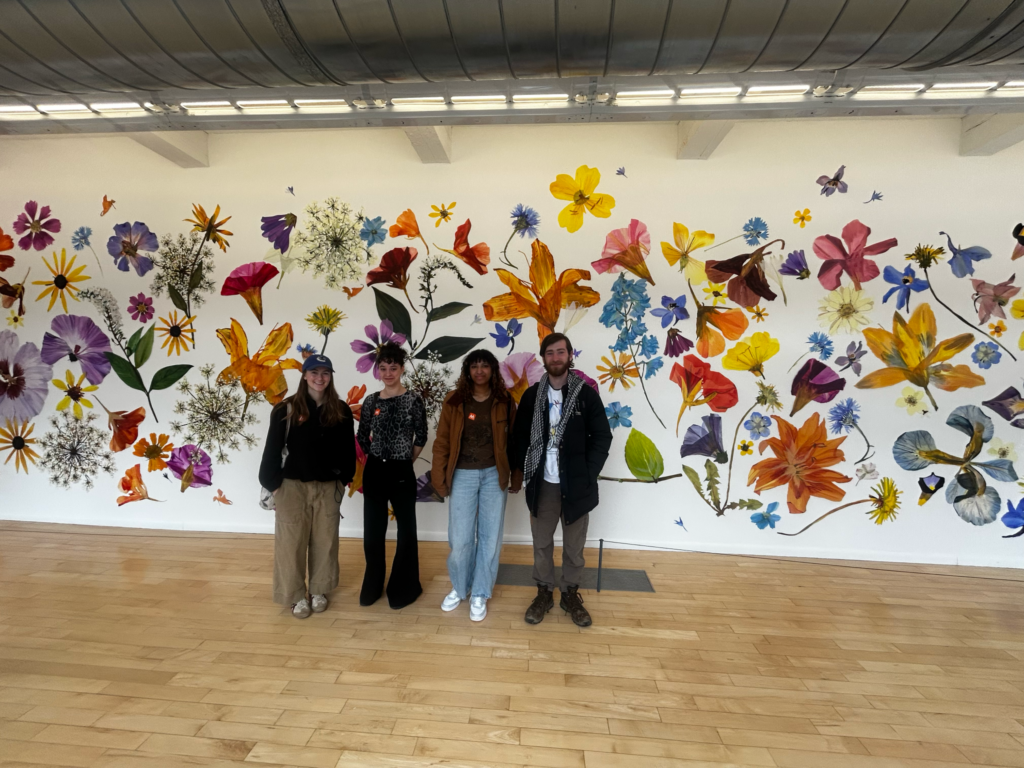
(Our group at the exhibition)
For our Better Know an Art Project presentation assignment, my group was assigned Carly Glovinski’s “Almanac” exhibition which is currently on display at Mass MoCa in North Adams,
MA. Because the exhibition was so close to Bennington College, and Mass MoCa offers free admission to students, my group had the unique opportunity to visit the exhibition in person. So, on one cloudy Sunday, my group and I piled into one of our cars and drove to North Adams to view the exhibition.
Glovinski is a Maine based artist from New Hampshire who graduated from Boston University’s BFA program, and is currently affiliated with the Morgan Lehman Gallery in New York City. She
Has had solo exhibitions and galleries across New England. She cites nature as a primary inspiration in creating her artworks, which span multiple mediums such as textiles, glasswork, and murals. Her latest work, Almanac, is no different. Inspired by the Flora of New England, Almanac focuses on the ephemerality and beauty of seasonal blooms found across New England, with literary influence on the project coming from May Sarton’s 1977 novel, House By the Sea, as well as Emily Dickinson’s love for plants conveyed within her writing, and the tradition of the Almanac, a publication which predicts seasonal and environmental patterns, and subsequently advises farmers on how to plan and grow their crops.
The process of creating this exhibition was a clear labor of love on Glovinski’s behalf. In order to most accurately convey the heart of her project; the almanac and ephemerality of nature, Glovinski took deliberate and painstaking care in the creation of Almanac. She collected her specimens from her own garden as well as from her friends, and seasonally harvested the flowers she wished to feature in the exhibition within their species bloom times, providing capsules of time to be preserved and later translated to her art. Glovinski then pressed each of the
flowers, and used the pressings of each flower as direct references in her painting process, using acrylic paint to illustrate on both sides of transparent mylar sheets. Often, multiple specimens of the same species are featured on the wall, showing how certain species appear throughout their bloom time and specimen nuance within a species, a clear indication of Glovinski’s dedication to accurately representing her subject matter. The flower paintings were then arranged within their bloom ranges, and scattered across the wall of the exhibit in an attempt to evoke a notion of the flowers being scattered by the wind. The exhibition features flowers over a timeline of early April-mid September, accompanied by a bloom chart to further help viewers understand deliberate placing of each painting.
When my group and I visited the exhibition, we found ourselves in awe at the sheer amount of detail visible in each painting; when laid across a blank wall, the paintings truly looked exactly the same as a flower pressing one might find in an herbarium, it was difficult to wrap my head around the fact that these had been painted by hand by someone, and not made by photocopying or any other
form of mechanical reproduction. Glovinski’s Almanac is a beautiful example of how art and science can intersect, and how the accessibility of art can lead the average person to have a better understanding and appreciation of science and nature as a whole. Works of art like Almanac allow the gap in the understanding of science to be filled in by artistic expression, and the freedom to interpret nature however one may perceive it, like how Glovinski did in this exhibition.
Leave a Reply